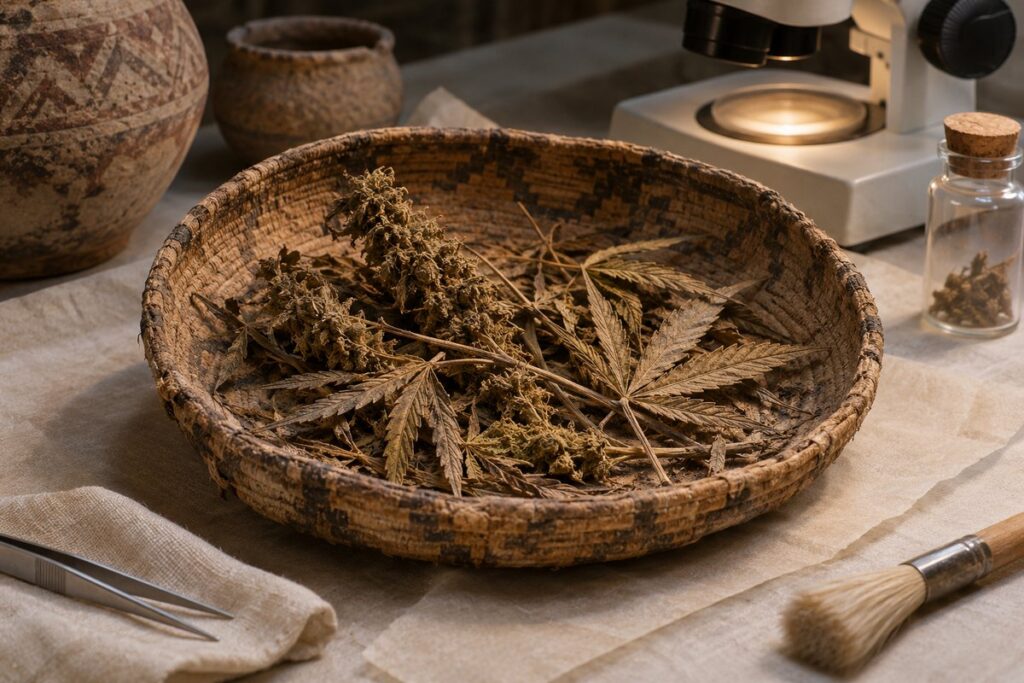
The first identification was coriander. That seems an unlikely beginning for one of the best-known archaeological studies of cannabis, until you consider what the excavators at Yanghai actually had: loose, dried plant material from a basket and a wooden bowl, buried near Turpan in what is now northwestern China. The plants had spent about 2,700 years underground. No label had come down with them.
Together the containers held 789 grams of material. Its exceptional preservation made it possible to put three questions to the same find. What plant parts could a botanist still recognize? Which chemicals had endured? Could a piece of the plant’s genetic machinery still be read? The answers overlap, but each one preserves something the other two have lost.
A seed coat and a gland
Under magnification, the material resolved into recognizable structures. Among them were achenes, the small dry fruits commonly called cannabis seeds, and the remains of glandular hairs called trichomes. You can see these details in the botanical and laboratory investigation. For an archaeobotanist, a feature as small as the surface of a fruit can be more informative than the general color or smell of a handful of fragments.
An earlier botanical comparison at Yanghai matched the form and anatomy of the ancient material with modern specimens. Plant anatomy also preserves a record of what was gathered. A bag of separated fibers would suggest one chain of activities; a collection containing leafy and reproductive material presents a different one. It is tempting to jump from that observation to a story about the person who collected the plants. The contents show which parts reached the grave. They cannot tell us who chose them or whether the choice was made specifically for the burial.
The chemistry of a long interval
The analysts detected cannabinoids, including cannabinol, or CBN. Its presence matters because THC can break down into CBN over time. An old specimen therefore presents a strange analytical problem. A chemical that was relatively scarce in the fresh material can become one of the more legible traces of what used to be there. A chromatogram of the tomb material belongs to the day the laboratory ran it.
To estimate the original THC concentration from that result, an analyst would need to know much more about the sample’s history. How much THC was present at burial? What conditions prevailed in the containers, and did those conditions stay the same? Detecting a compound after thousands of years is remarkable in itself. Treating the number on the instrument as the potency of a freshly picked flower would give that number a meaning it cannot bear.
A surviving stretch of genetic instructions
The team also amplified ancient DNA corresponding to the gene for THCA synthase. In a living plant, that enzyme helps make the acidic precursor of THC. A surviving stretch of the gene supplies a second route to a conclusion already suggested by the chemical remains: this plant possessed genetic machinery associated with producing that precursor. Reading the sequence cannot tell us how active the enzyme was in a particular flower on the day of harvest.
What did people do with it?
Different burials preserve different evidence of human action. At nearby Jiayi, researchers described thirteen nearly whole cannabis plants laid across a body. Arrangement carries meaning there because the relative positions of the stalks survived. Farther west, at Jirzankal in the Pamirs, chemical traces came from the charred interiors of wooden braziers. The scorching adds evidence about heating that loose plant fragments alone could never provide.
At Yanghai, the basket, the bowl and their placement establish a deliberate association with a burial. The fruit, glands, chemical residues and DNA make a strong case for the identity of the material inside. Whether a living person once swallowed it, inhaled it, used it as medicine or reserved it for a ceremony is a different question. The original coriander identification could be corrected by examining the deposit more closely. Those details of a person’s life may simply never have entered the deposit at all.