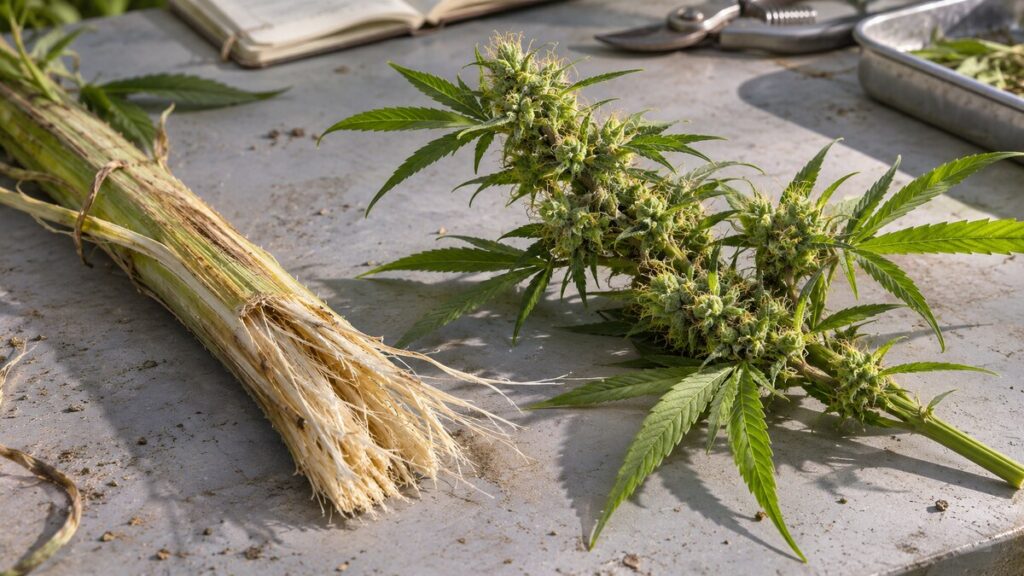
A rope maker looking over a stand of cannabis has reason to pay attention to the stems. A collector of aromatic flowers might walk through the same stand and notice quite different plants. Neither person needs to know anything about genes. If their choices influence which plants leave descendants, the differences can eventually become apparent to someone who has never seen either the rope or the flowers. They can turn up in a sample of DNA.
Two histories in the same species
In 2015, Jason Sawler and colleagues compared more than fourteen thousand positions in the DNA of 43 hemp samples and 81 samples classified as marijuana. The genetic comparison found differences distributed across the genome. Someone seeking to distinguish the groups could learn something from regions well beyond those directly involved in producing intoxicating compounds. The two sets of plants had different breeding histories as well as different chemistry.
A statistical separation between two groups does not give each individual plant an unambiguous identity. Think of sorting photographs of working dogs by their jobs. There may be recognizable tendencies in size and build, but a photograph of one dog cannot establish what its owner actually asks it to do. Genetic ancestry, chemical composition and agricultural use likewise answer different questions about cannabis. A legal designation adds another question with its own definition.
The shape of the stem matters
A whole-genome investigation of 110 cannabis accessions looked for stretches of DNA that bore evidence of different selection histories in hemp and drug-type plants. Among the candidates were genes associated with branching and with the production of cellulose and lignin. Those are plausible places to look for evidence of human preferences. A long stem with few interruptions presents a fiber processor with a different raw material from a plant invested in numerous flowering branches.
Cellulose helps give plant cell walls their strength. Lignin contributes to the properties of woody tissues. The proportion and arrangement of tissues in a stem matter to a person who wants to separate long fibers from the surrounding material. But a stretch of DNA showing unusual variation is a lead. It cannot tell the researcher precisely which quality an individual farmer liked, whether the quality was measured deliberately, or whether it accompanied another favored trait.
Genes can travel together
A selected trait can leave a signature in neighboring DNA. A plant that happens to carry a favorable variant also carries many other variants nearby. As its descendants become numerous, some neighbors may become common along with it. Recombination can break up the association over generations, but it does not do so at the same rate everywhere. Reading a statistical map is therefore more like identifying a promising neighborhood than finding a name on a door.
A physical and genetic map of cannabis shows why the distinction is especially relevant here. Regions containing genes for enzymes involved in cannabinoid production have extensive repetitive DNA and structural differences. A short sequence read can be difficult to assign to the right location when similar stretches occur repeatedly. More complete maps can change how confidently researchers interpret what looked like an absent gene or a simple difference between two plants.
A plant has several pedigrees worth asking about
Modern retail names complicate matters further. A study comparing commercial labels with chemistry and genetics found relationships with variation in particular aromatic compounds that were poorly summarized by broad genetic ancestry. A name meaningful to a person who recognizes a smell may be an unreliable description of an entire genome.
The rope and the flower are consequently better starting points than a contest to find one defining gene. They tell us what kinds of differences people might have noticed. Population comparisons show which differences accumulated together. Mapping then gives researchers a chance to separate changes that mattered to those people from changes that simply came along for the ride.